




Illustrative imagery

Consumer health20256–9 months

Nine markets, one brand system

Client: A consumer-health brand sold in nine markets

A plain card carton beside a frosted glass jar with a blank label, on a pale stone ledge.
Read the story
  • Brand Design
  • Campaign & Content Design
  • AI Design

At a glance

The brief. Hold one brand across nine markets without slowing any of them down.

Client
A consumer-health brand sold in nine markets
Year
2025
Duration
6–9 months
Scale
9 markets

Picture story

Nine shelves. One pack grid.

The pictures on this page are illustrative: licensed stock photography and code-built mock-ups chosen to show the setting, not the client’s own work. Credits are at the foot of the page.

A blank pale pink carton and a white tube with a pink cap against a soft pink wall.
Fig. 01Carton and tube: two of the formats one pack grid has to hold.Avtar Singh on Unsplash (opens in a new tab)
An amber glass dropper bottle with a blank label standing on a concrete block.
Fig. 02The smallest label follows the same rules.Avtar Singh on Unsplash (opens in a new tab)
Colour swatch cards fanned into a full circle on a grey surface.
Fig. 03Colour comes from tokens, not from each market’s printer.Andy Brown on Unsplash (opens in a new tab)
Four colleagues lean over printed pages on a wooden table, one pointing at a detail.
Fig. 04Market leads review printed variants against the shared rules.Andreea Avramescu on Unsplash (opens in a new tab)
A night market seen from above, its long street lined with lit stalls between tall apartment blocks.
Fig. 05Nine markets, nine retail settings.Willian Justen de Vasconcellos on Unsplash (opens in a new tab)
Pedestrians cross a wet city street at dusk, car headlights reflected on the road.
Fig. 06One system has to read in all of them.Donny Jiang on Unsplash (opens in a new tab)

On screen

One source of truth. The guidelines site and the agent that reads it.

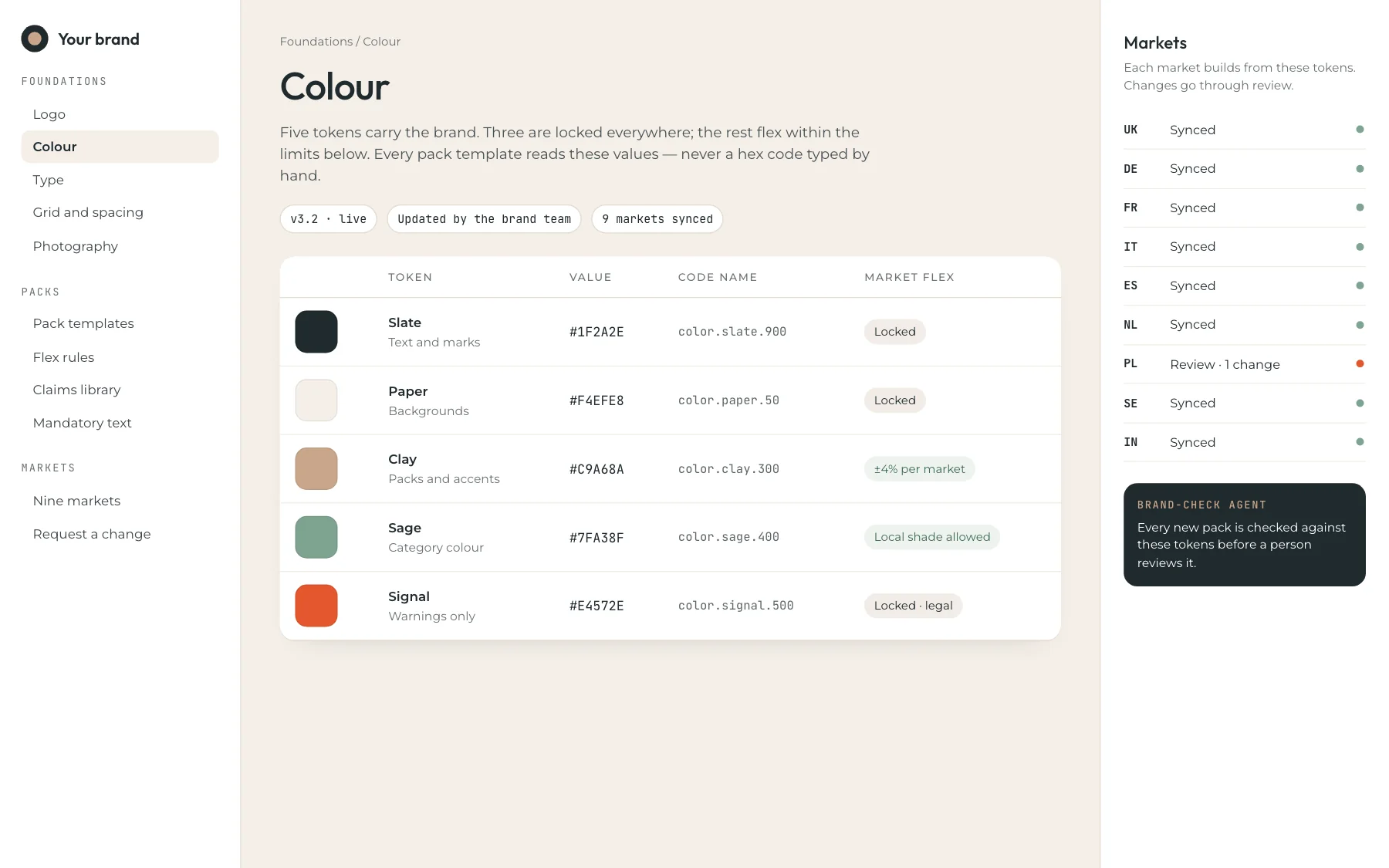
Illustrative screens, built in code to show the kind of screen the programme produced — not the client’s own. Open any of them full screen.

Illustration: a living brand guidelines site open at Colour, listing five colour tokens with their values and the rule for which markets may flex each one.
DesktopThe living guidelines site: tokens, pack templates and the flex rules for each market.
Illustration: a phone showing a brand-check result for a pack. Four checks pass; the claim check is flagged and routed to medical-legal review.
PhoneThe brand-check agent on a reviewer’s phone: one claim flagged, routed and logged.

Before and after

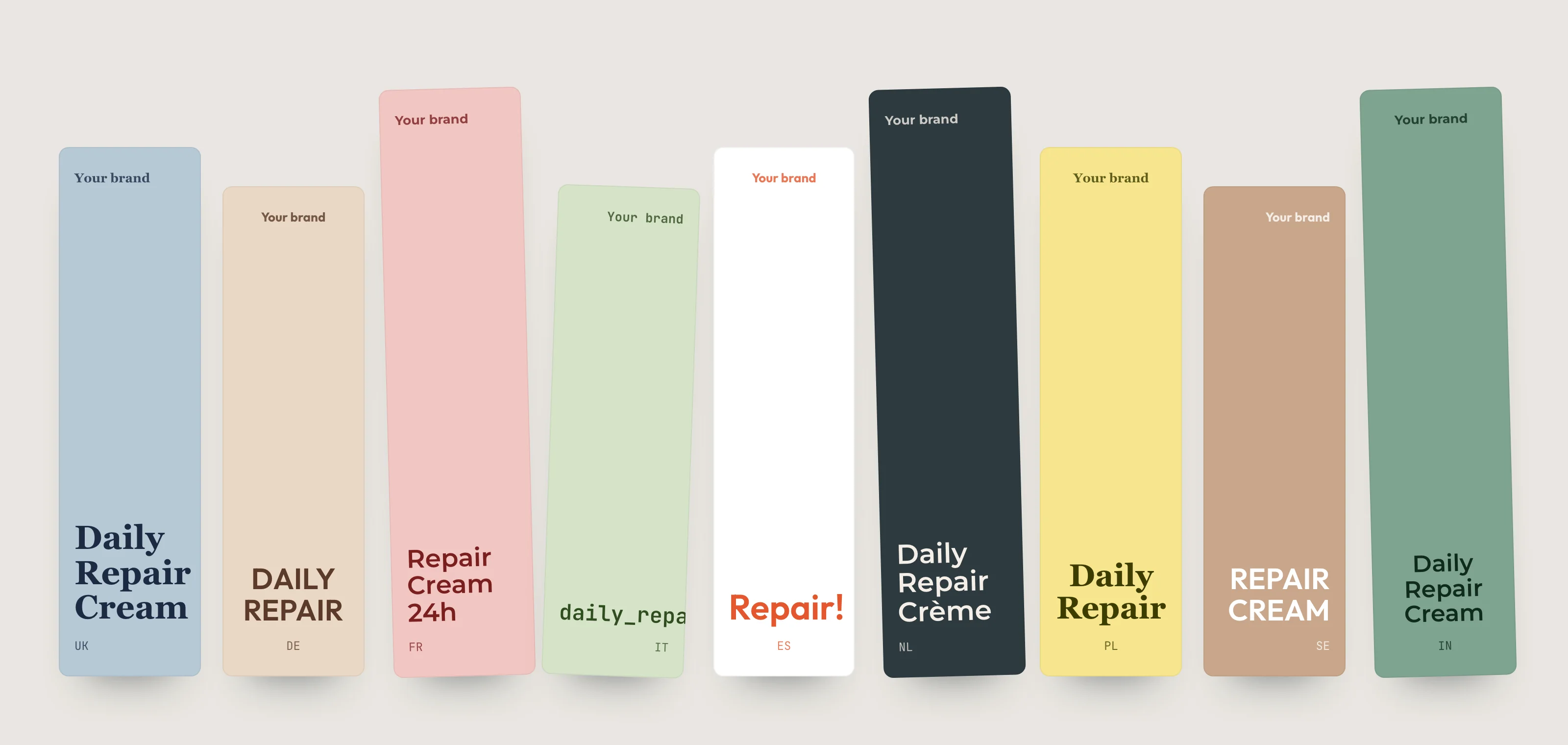
Nine versions, then one. The same pack, before and after the system.

An illustrative before and after, built in code to show the kind of change the work made — not the client’s own screens. Drag across the picture to compare.

Illustration: nine versions of the same pack, each with a different colour, type style and layout. Before · nine local versions
Illustration: the same nine packs built on one grid, colour and type consistent, each with its own market code. After · one grid
Before · nine local versionsAfter · one grid The same product across nine markets, before and after the pack system. Illustrative.

From brief to result

From rules to rollout. Nine markets, one system.

The brief in full, how we approached it, what we built and what it set out to change.

The brief, in full

Nine markets were adapting the brand on their own. Packs, claims and campaign assets were rebuilt locally, so the same product could look and sound different from one border to the next, and every new asset went through the full review cycle again.

The brief was to hold one brand across all nine without slowing any market down — and to keep every health claim traceable to its approval.

Our approach

We started from the rules, not the logo: what must never change, what a market may flex, and who signs off. Those rules became design tokens and pack templates, so a market builds from the system instead of copying last year’s files.

Claims were treated as data. Each approved claim carries its markets, its evidence and its review date, and the brand-check agent reads that library before any asset reaches a person.

How it ran

  1. Weeks 1–4Audit

    Every live pack and asset across the nine markets, laid out on one grid.

  2. Weeks 5–10Rules

    Fixed, flexible and local: three tiers written down and agreed with each market lead.

  3. Weeks 11–20System

    Tokens, pack templates and the claims library, published as a living guidelines site.

  4. Weeks 16–24Agent

    The brand-check agent, tested on past assets before it saw a new one.

  5. Months 6–9Rollout

    Market by market, with a person approving every asset the agent flags.

What we built

A token-based brand system with market-level flex rules, a shared claims library and a brand-check agent that flags drift before assets reach review.

What it left behind

  1. Brand guidelines as a living site
  2. Design tokens and pack templates
  3. Claims library with approval history
  4. Brand-check agent and audit log

What changed

The system is built so every market starts from the same tokens, templates and approved claims, and so the brand-check agent reviews each asset first — routing anything it flags (an unsupported claim, an off-palette colour) to a named reviewer, with the decision logged.

Whether that holds is judged market by market on the three measures below. The figures stay with the client until they approve publishing them.

How it is measured

Brand kit

Slate, paper and clay. A palette built to flex by market.

The colours with their roles, share of use and contrast, and the typefaces with their jobs. Press a colour to copy its code.

Colour

  • Slate #1F2A2E

    Text and marks

    On white
    14.7:1 AAA
    On near-black
    1.2:1 Fails
  • Paper #F4EFE8

    Backgrounds

    On white
    1.1:1 Fails
    On near-black
    15.3:1 AAA
  • Clay #C9A68A

    Packs and accents

    On white
    2.3:1 Fails
    On near-black
    7.8:1 AAA
  • Sage #7FA38F

    Category colour

    On white
    2.8:1 Fails
    On near-black
    6.3:1 AA
  • Signal #E4572E

    Warnings and mandatory text only

    On white
    3.7:1 AA large
    On near-black
    4.8:1 AA
Share of use Slate 40%, Paper 32%, Clay 14%, Sage 9%, Signal 5%

Type

  • DisplayMedium 500Semibold 600

    A humanist sans, licensed

    One system. Nine markets.

  • Text and packsRegular 400Medium 500

    A neo-grotesque with wide language support

    Read the label before use. Keep out of the reach of children.

Specimens are set in this site’s own typefaces as stand-ins; each card names the project’s family.

Field notes

In detail. Notes from the programme.

Why the agent never approves

A health claim that is wrong in one market is a regulatory problem, not a style problem. So the agent was built to find and route, never to sign off: it compares each asset with the tokens, the pack grid and the claims approved for that market, and sends anything it cannot match to a named reviewer.

The agent flags and routes. A person decides.

The programme’s working rule
  • Colours within the token tolerance
  • Type set in the approved families and sizes
  • Every claim present in the approved library for that market
  • Pack grid, mandatory text and warnings in place
  • The decision and the reviewer logged against the asset

Outcomes

Judged market by market. Review, speed and reuse.

What each measure is compared with, when it is read and who reports it — and the results, once the client approves them.

The measurement plan

  1. Assets passing brand review first time

    Compared with
    Each market’s review log for the year before the system
    Read
    Quarterly, from each market’s first month on the system
    Result
    Awaiting approval Reported by The client’s brand team
  2. Brief-to-approved time per market

    Compared with
    Median days from brief to approval before rollout
    Read
    Three months after each market switches over
    Result
    Awaiting approval Reported by Market leads, from the approval workflow
  3. Share of assets built from templates

    Compared with
    Template use in the asset library before rollout
    Read
    Monthly, from the asset library
    Result
    Awaiting approval Reported by Brand operations

Results

Figures pending client approval

We publish results only with the client’s written approval. Until then, the plan beside this is what the programme is judged on, and we can walk you through it under NDA.

Credits

The team and the pictures.

People are named only with their agreement.

Team 8 people

  • Programme lead × 1
  • Brand strategist × 1
  • Design lead × 1
  • Designers × 3
  • Design technologist × 1
  • AI engineer × 1

Credits

Strategy, design and engineering
Xterra Edze
Screens and before-and-after views
Xterra Edze (code-built illustrations)
Photography
Licensed stock from Unsplash, credited picture by picture

Pictures 11

Licensed stock photography and code-built mock-ups, chosen to show the setting — not the client’s own work.

Next case · 02 · Financial services

A CRM that knows what happened last

Make every customer message aware of the last thing that happened.

Read the next case

Let’s build what happens next.

Tell us what you’re building. We’ll answer straight.

Book a discovery call

Three ways to start

  1. 01About 2 minutes

    A quick question

    You get A reply from a lead, not a sales queue

  2. 02About 8 minutesMost useful

    A project brief

    You get Options and a first scope after one call

  3. 03About 15 minutes

    A formal RFQ or RFP

    You get Receipt confirmed and a named bid lead

Every engagement starts with a written scope and a quote agreed before work begins. How each package is priced