Illustrative imagery

Retail & commerce20253–4 months

Visible in AI answers, not only in search

Client: An omnichannel retailer

One of the project’s screens, in a phone frame. It is shown again with its caption under “On screen”.

Read the story
  • Marketing Technology
  • Technology & Intelligence
  • Campaign & Content Design

At a glance

The brief. Be cited in AI answers, not only ranked in search results.

Client
An omnichannel retailer
Year
2025
Duration
3–4 months
Scale
Search and AI assistants

From brief to result

Questions first, content second. How the panel was built.

The brief in full, how we approached it, what we built and what it set out to change.

The brief, in full

Shoppers were asking AI assistants which product to buy, and the answers cited review sites and forums — rarely the retailer’s own guides, even where those guides were the better source. A search ranking no longer described how visible the retailer was.

The brief: be cited in AI answers, not only ranked in search results.

Our approach

We fixed the questions before touching the content: a panel of priority questions shoppers actually ask, checked on a schedule across the main AI assistants, so visibility could be measured rather than guessed.

Then we made the product data and the category content easy to cite: complete structured data, clean feeds, and guides written as direct answers with the evidence beside them.

How it ran

  1. Weeks 1–2Panel

    Priority questions by category, each with the answer we would want cited.

  2. Weeks 2–8Data

    The product data model, feeds and schema markup brought to complete.

  3. Weeks 4–12Content

    Category guides rewritten as direct answers, each with its sources.

  4. OngoingTracking

    The panel re-run on a schedule; citations reported by category and by assistant.

What we built

Structured product data, schema markup and answer-shaped content, tracked against a fixed panel of priority questions across AI assistants.

What it left behind

  1. Priority-question panel
  2. Product data model and feeds
  3. Category content templates
  4. Visibility tracking report

What changed

The work sets out to make the retailer’s product data complete and its guides citable, and gives it a way to see, question by question, which assistants cite its guides and which cite someone else.

Share of AI answers is read from the fixed panel. The client approves any figure before it is published.

How it is measured

Picture story

Where shoppers ask now. In an assistant, a search box, a store aisle.

The pictures on this page are illustrative: licensed stock photography and code-built mock-ups chosen to show the setting, not the client’s own work. Credits are at the foot of the page.

Close-up of two hands holding a phone, a thumb on the screen, light denim in the background.
Fig. 01The question now starts in an assistant.Darya Ezerskaya on Unsplash (opens in a new tab)
A woman leans over a laptop at a small table, taking notes as she browses.
Fig. 02Or in a search box that answers back.Tran Mau Tri Tam on Unsplash (opens in a new tab)
A runner heads down a straight country road towards the setting sun.
Fig. 03Category guides rewritten as direct answers, with their evidence.Jonathan Borba on Unsplash (opens in a new tab)
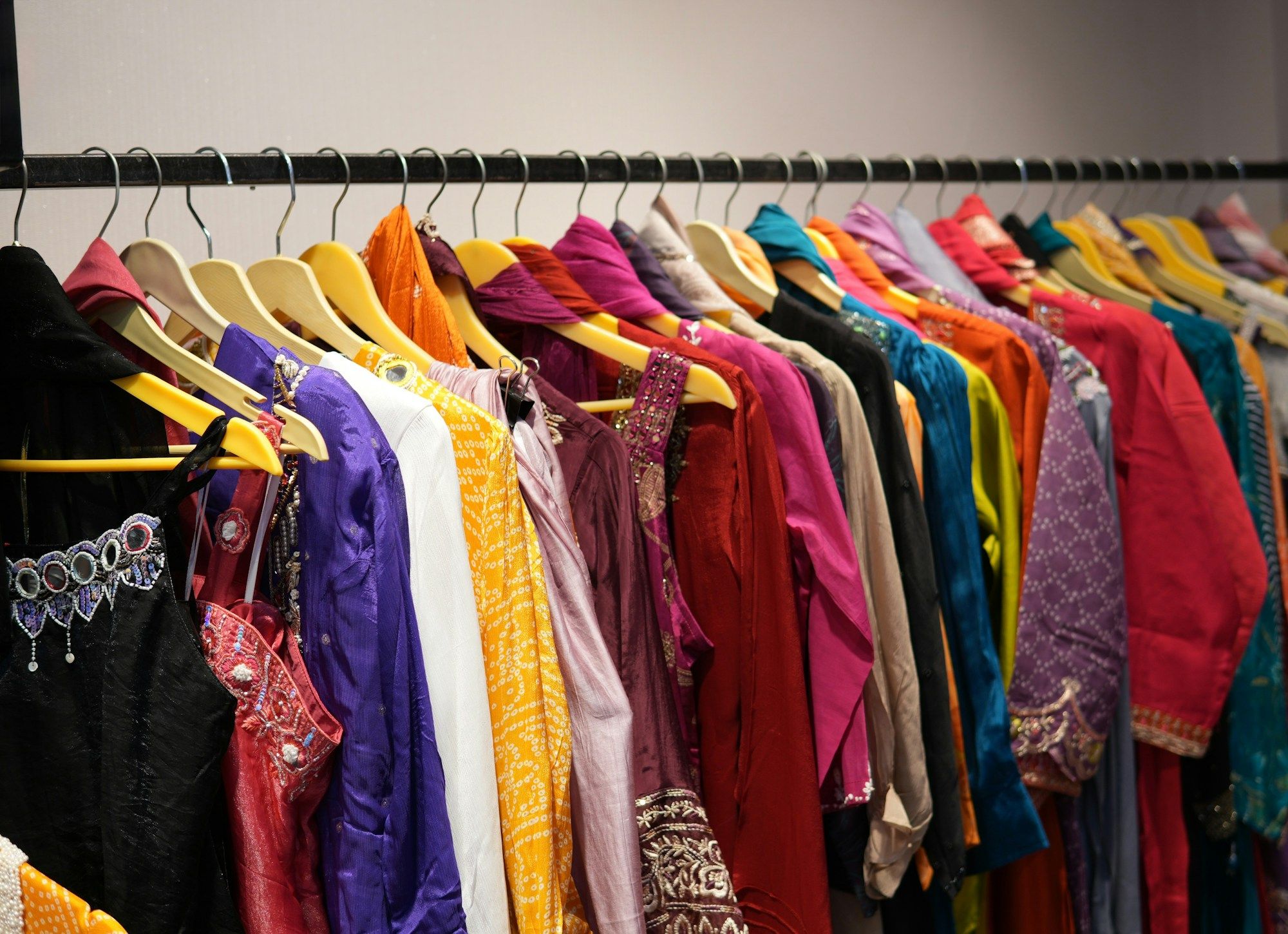
A rail of brightly coloured garments on yellow hangers in purple, orange, red and teal.
Fig. 04Complete product data — every size, colour and fit — in the feed the answers draw on.Harsh Khandelwal on Unsplash (opens in a new tab)
A woman looks along a clothing rail in a bright store, a polka-dot dress in the foreground.
Fig. 05In the store and online, the same answer.Vitaly Gariev on Unsplash (opens in a new tab)

On screen

Cited first. The answer, and the tracker that checks it.

Illustrative screens, built in code to show the kind of screen the programme produced — not the client’s own. Open any of them full screen.

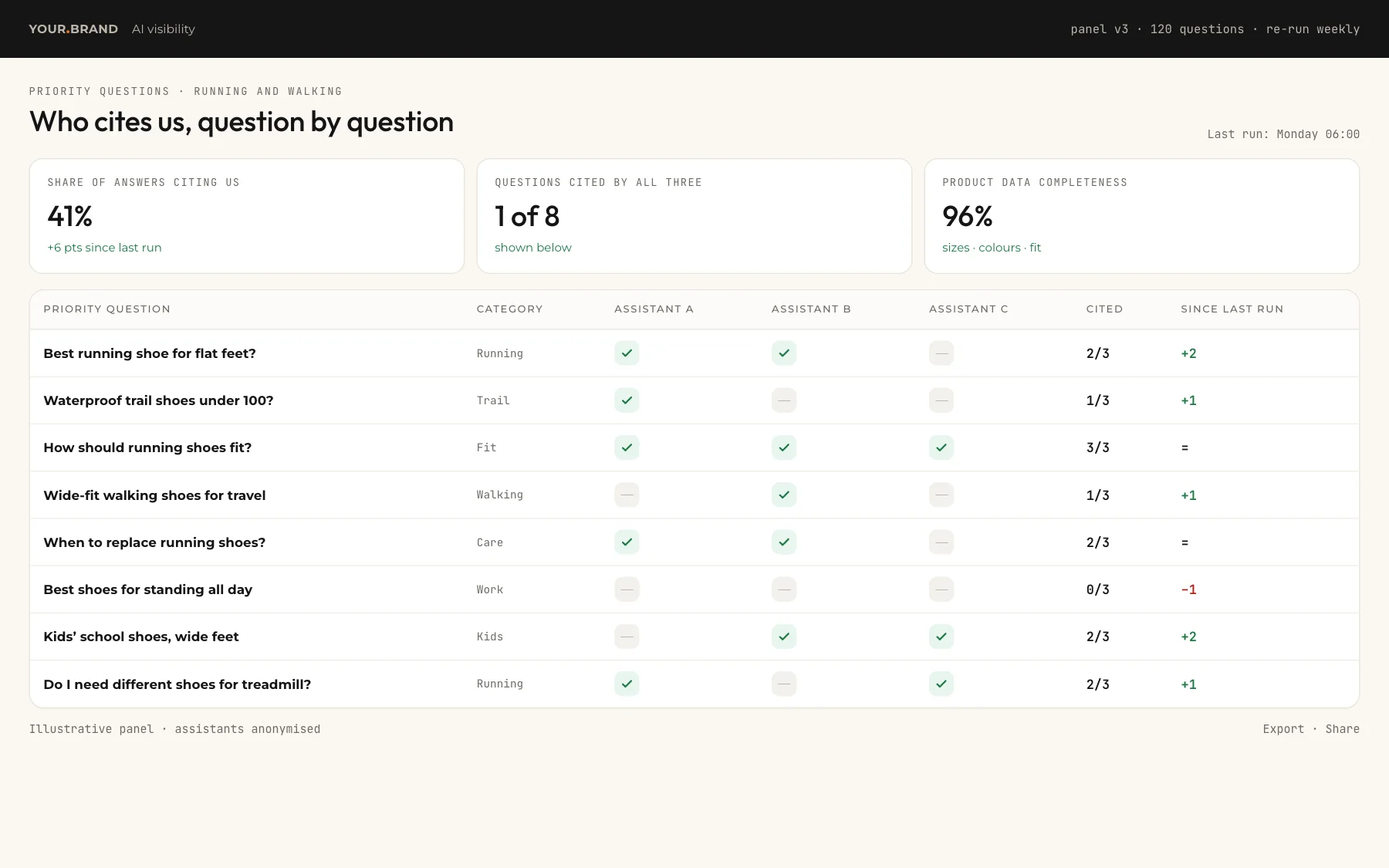
Illustration: a visibility tracker listing priority questions, the assistants checked, whether each answer cites the brand, and the change since the last run.
DesktopThe tracker: the same questions, re-run on a schedule.
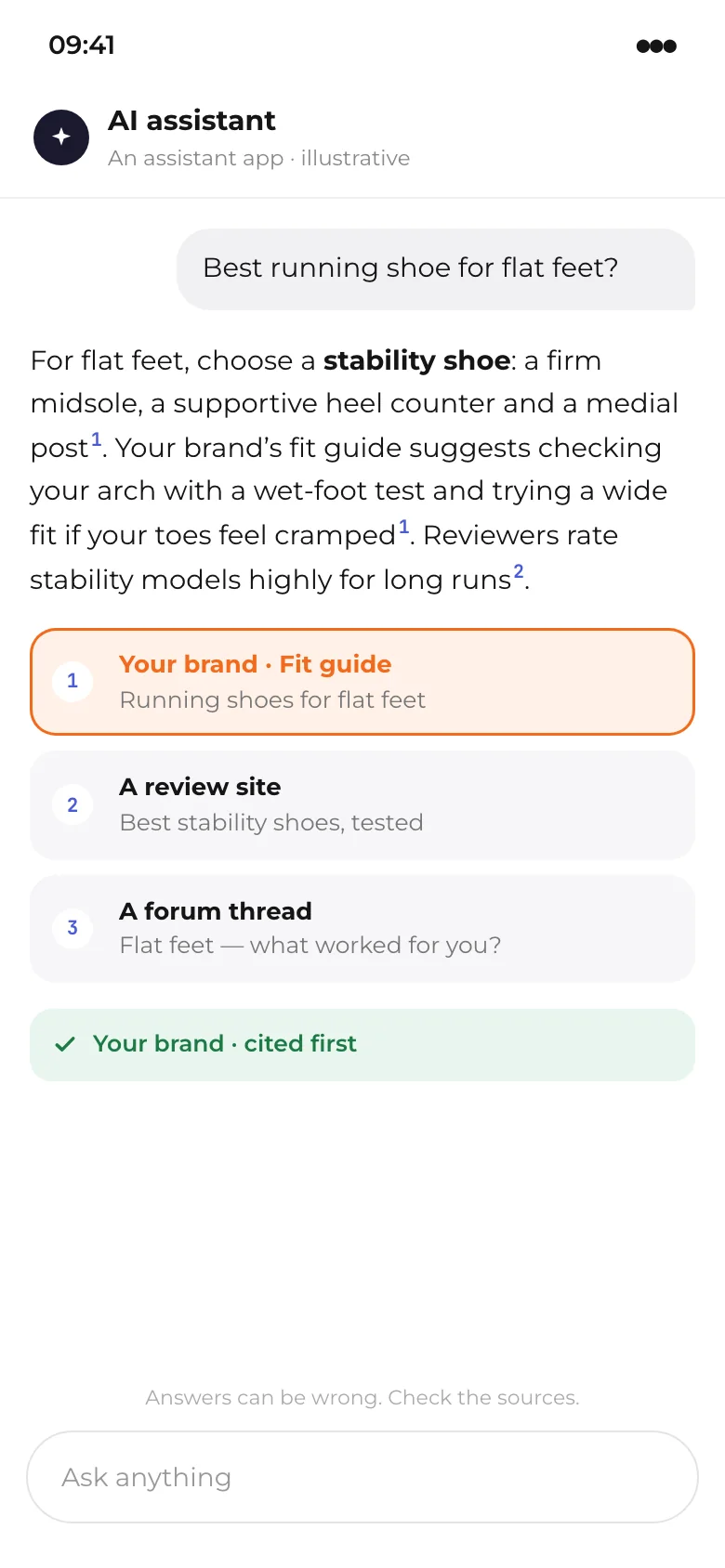
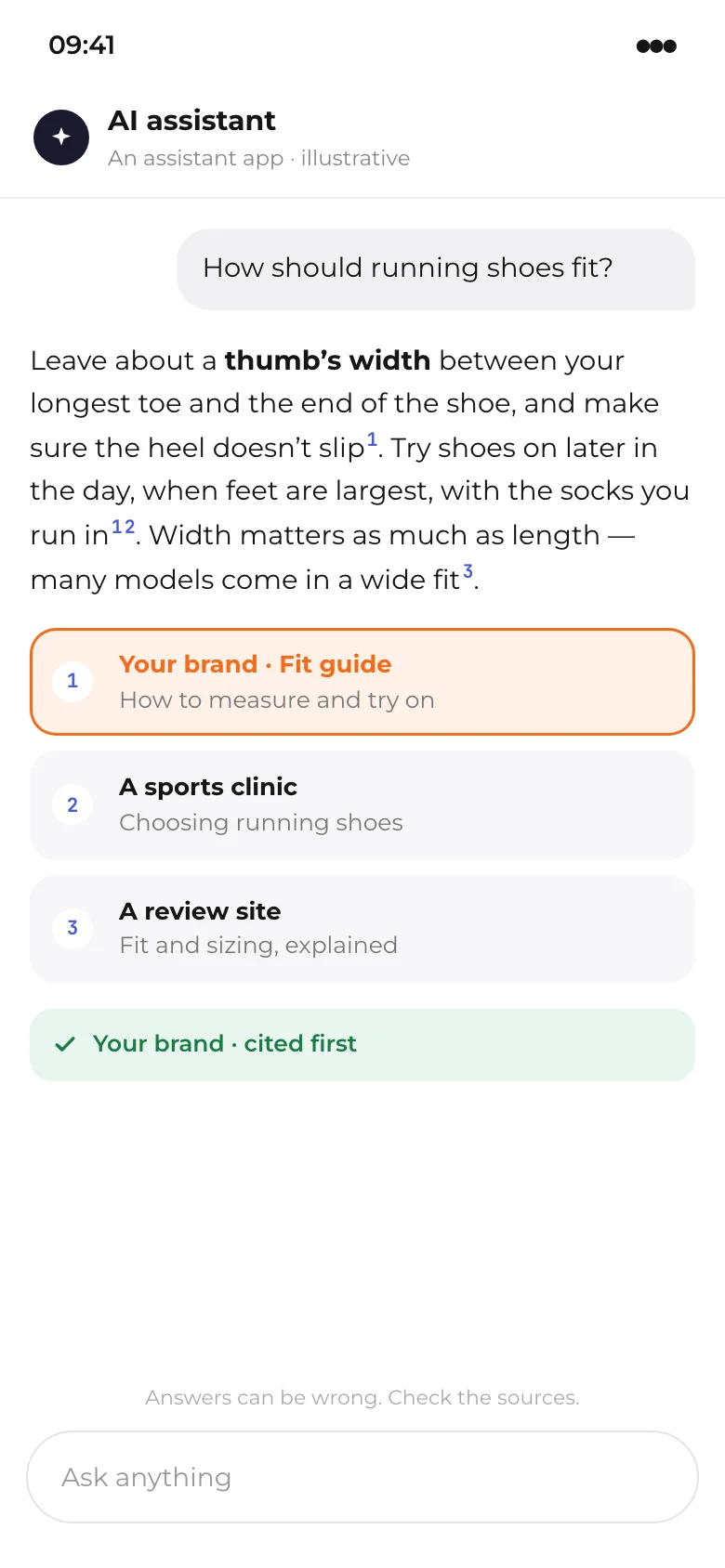
Illustration: an AI assistant on a phone answers “How should running shoes fit?” and cites the brand’s fit guide first among three sources.
PhoneAn AI answer that cites the retailer’s own fit guide first.

Before and after

Not cited, then cited. The same question, before and after.

An illustrative before and after, built in code to show the kind of change the work made — not the client’s own screens. Drag across the picture to compare.

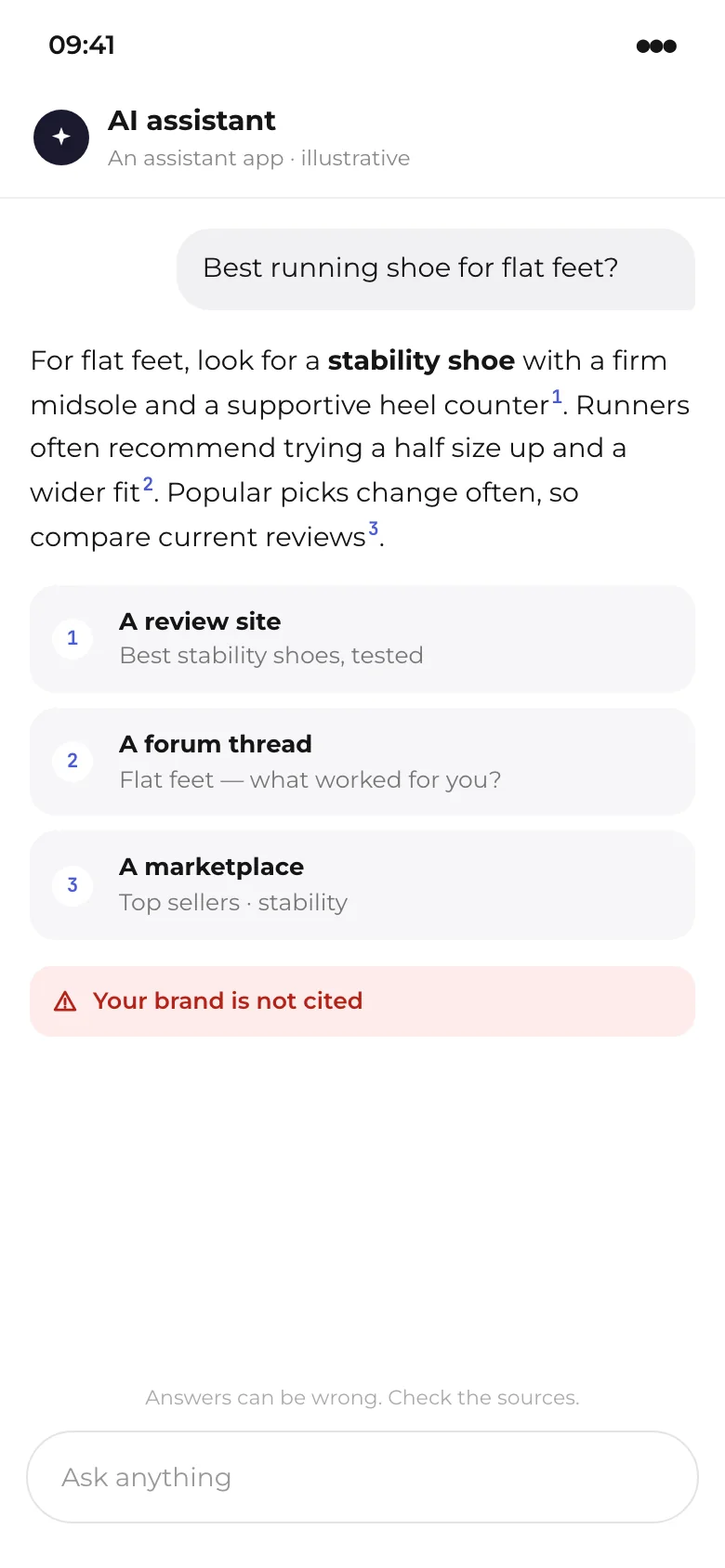
Illustration: an AI answer on a phone citing a review site, a forum and a marketplace, and not the brand. Before · not cited
Illustration: the same question answered with the brand’s fit guide cited first. After · cited
Before · not citedAfter · cited The same priority question, before and after. Illustrative.

Outcomes

Judged on a fixed panel. Question by question.

What each measure is compared with, when it is read and who reports it — and the results, once the client approves them.

The measurement plan

  1. Share of AI answers citing the brand

    Compared with
    The first run of the question panel
    Read
    Each scheduled re-run of the panel
    Result
    Awaiting approval Reported by The search lead
  2. Organic revenue from priority categories

    Compared with
    The same season the year before
    Read
    Quarterly
    Result
    Awaiting approval Reported by The client’s ecommerce team
  3. Product data completeness

    Compared with
    A field-by-field audit of the feed at the start
    Read
    Monthly, from the feed checks
    Result
    Awaiting approval Reported by The client’s data team

Results

Figures pending client approval

We publish results only with the client’s written approval. Until then, the plan beside this is what the programme is judged on, and we can walk you through it under NDA.

Credits

The team and the pictures.

People are named only with their agreement.

Team 6 people

  • Search lead × 1
  • Data engineer × 1
  • Content strategist × 1
  • Writers × 2
  • Analyst × 1

Credits

Strategy, design and engineering
Xterra Edze
Screens and before-and-after views
Xterra Edze (code-built illustrations)
Photography
Licensed stock from Unsplash, credited picture by picture

Pictures 9

Licensed stock photography and code-built mock-ups, chosen to show the setting — not the client’s own work.

Next case · 05 · Retail & commerce

A season shipped in days, not weeks

Take a season from six weeks and three agencies down to days.

Read the next case

Let’s build what happens next.

Tell us what you’re building. We’ll answer straight.

Book a discovery call

Three ways to start

  1. 01About 2 minutes

    A quick question

    You get A reply from a lead, not a sales queue

  2. 02About 8 minutesMost useful

    A project brief

    You get Options and a first scope after one call

  3. 03About 15 minutes

    A formal RFQ or RFP

    You get Receipt confirmed and a named bid lead

Every engagement starts with a written scope and a quote agreed before work begins. How each package is priced